
Who This Is For: Anyone installing a new chandelier over a dining table, or rehanging one that feels too high, too low or simply off, who wants a clear target and a practical way to hit it.
Key Takeaways
- Quick Answer: 30 to 36 Inches Above the Table
- Why This Range Works
- Hanging Height by Ceiling Height
- Adjusting for the Style of Fixture
- How to Set the Height Step by Step
- Real Dining Rooms: Common Situations
- Brightness, Color and Dimming
- Common Mistakes to Avoid
- Final Advice
A dining chandelier does two jobs at once. It lights the table so you can see the food and the faces around it, and it anchors the room visually. Hang it too high and it drifts away from the table, leaving the surface dim and the fixture looking lost near the ceiling. Hang it too low and it blocks the view across the table, shines into eyes, and gets bumped every time someone leans in to pass a dish.
The good news is that there is a well established starting point that works in most homes, and a simple way to adjust it. Below you will find the standard measurement, a table for different ceiling heights, how to adjust for the style of fixture, and a step by step method for setting the height without guesswork.

Quick Answer: 30 to 36 Inches Above the Table
With a standard 8 foot ceiling, hang the chandelier so the bottom of the fixture sits 30 to 36 inches above the table top. For each additional foot of ceiling height, raise it by about 3 inches. On a 9 foot ceiling that means 33 to 39 inches, and on a 10 foot ceiling, 36 to 42 inches.
Always measure from the table top, not the floor, and always measure to the lowest point of the fixture, including any hanging crystals or bulbs.
Why This Range Works
The 30 to 36 inch range is not arbitrary. It balances three things that pull in different directions.
- Sight lines. A standard dining table is about 29 to 30 inches tall, so a fixture hung in this range ends up roughly 5 feet or a little more above the floor, which keeps it above the eye line of people seated at the table. Guests can see each other without leaning around the light.
- Useful light. Light spreads and weakens with distance. A fixture close to the table puts a bright, even pool on the surface. A fixture near the ceiling spreads its output over the whole room and leaves the table dimmer.
- Proportion. When the fixture sits close to the table, the two read as one arrangement. When there is a large gap, the chandelier looks disconnected, as if it belongs to the ceiling rather than the table.
Within the range, the low end suits smaller, lighter fixtures and more intimate rooms. The high end suits larger fixtures, busier rooms and families with tall members who stand up and sit down often.
Hanging Height by Ceiling Height
Use this table as a quick reference. The floor measurements assume a 30 inch table, which is typical, so adjust if yours is taller or shorter.
| Ceiling height | Table top to fixture bottom | Approximate floor to fixture bottom |
|---|---|---|
| 8 feet | 30 to 36 inches | 60 to 66 inches |
| 9 feet | 33 to 39 inches | 63 to 69 inches |
| 10 feet | 36 to 42 inches | 66 to 72 inches |
| 11 feet | 39 to 45 inches | 69 to 75 inches |
| 12 feet | 42 to 48 inches | 72 to 78 inches |
Above 12 feet, or in a vaulted room, the extra height is mostly empty space above the fixture. Keep the fixture in a comfortable relationship with the table rather than letting it climb toward the ceiling, and choose a taller or larger fixture so the long drop does not look spindly. On a sloped ceiling, you will need a canopy that allows the chain or rod to hang straight, and the measurement is still taken from the table.
Adjusting for the Style of Fixture
The ceiling rule gets you close. The fixture itself decides where you land within the range.

Soft shades can sit a little lower
Fixtures with fabric, paper or frosted glass shades hide the bulbs and diffuse the light, so they can hang toward 30 inches without dazzling anyone. Open frames with exposed bulbs are different: if a bare bulb lands at eye level for someone seated, it becomes a glare source. Raise those fixtures toward the top of the range, or use lower output bulbs with a frosted finish.

Linear fixtures over long tables
Linear fixtures follow the same 30 to 36 inch rule. Because they are long and usually slim, they can often sit toward the lower end without blocking views. Center the fixture along the length of the table and leave at least 6 inches between each end of the fixture and the end of the table. Our linear suspension lights hang from two or more cables, so check that both cables can be adjusted evenly.
Large, heavy or solid fixtures
A wide drum shade or a dense crystal chandelier has a lot of visual mass. Hung low, it can feel like it is pressing down on the table. Start at the higher end of the range and lower it only if the room feels too open. Also check the total weight against the ceiling box rating before you install anything heavy.
Tall fixtures
With a tall fixture, the bottom might hit 33 inches above the table while the top ends up only a few inches below the ceiling. That is fine. The rule always refers to the lowest point of the fixture, and a tall chandelier on a short chain often looks better than a short one on a long chain.
Groups of pendants
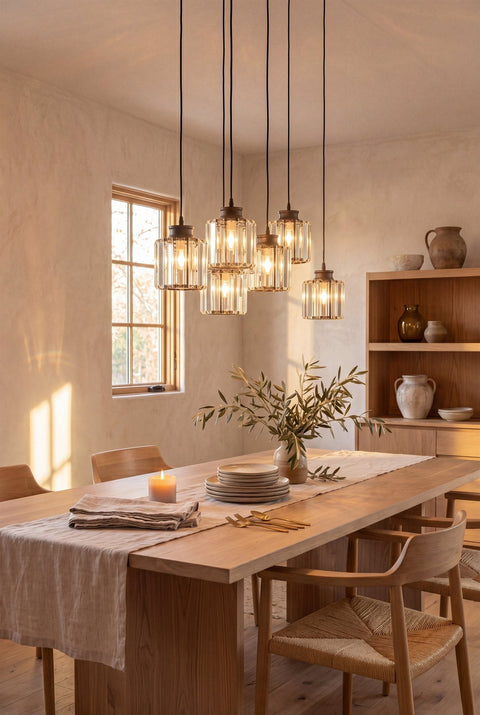
A row of pendants over a dining table is sized and hung like a single fixture. Keep the bottoms of all the pendants at the same height, within the 30 to 36 inch range, and space them evenly. Browse our pendant lights if you prefer that look to one central fixture.
How to Set the Height Step by Step
Most chandeliers hang from a chain, rods or adjustable cables, and all of them need to be set to the right length. Doing the math first saves you from cutting a chain too short.
- Measure the ceiling to the table top. On an 8 foot (96 inch) ceiling with a 30 inch table, that distance is 66 inches.
- Choose your target gap. Say 33 inches, the middle of the range for an 8 foot ceiling.
- Subtract the gap from the ceiling to table distance. 66 minus 33 leaves 33 inches for the canopy, chain and fixture together.
- Subtract the fixture height and canopy. If the fixture body is 20 inches tall and the canopy takes up 3 inches, you need about 10 inches of chain or rod.
- Test before you commit. With a helper, hold the fixture at the planned height, or hang it temporarily, and sit at the table. Look across it, lean forward, stand up. Adjust by an inch or two if needed.
- Turn off the power before you adjust. Switch off the circuit at the breaker, not just the wall switch, and confirm the wires are dead with a non contact voltage tester before you touch any wiring.
- Remove the extra length. Open or remove chain links with pliers, take out rod sections, or slide cable grippers per the instructions. Shorten the fixture wires to match, leaving enough slack to make the connections comfortably inside the box.
If rewiring is involved, the fixture is heavy, or the electrical box needs to be moved to center the light over the table, have a licensed electrician do the work and follow your local electrical code.
Real Dining Rooms: Common Situations

The table is not under the electrical box
This is very common, especially when a table is shifted to make room for a sideboard. The fixture should be centered over the table, not the room. A swag hook in the ceiling can carry the chain over to the right spot, with the chain and cord visible between the two points, which suits relaxed and traditional rooms. For a cleaner result, an electrician can move the box.
The ceiling is very low
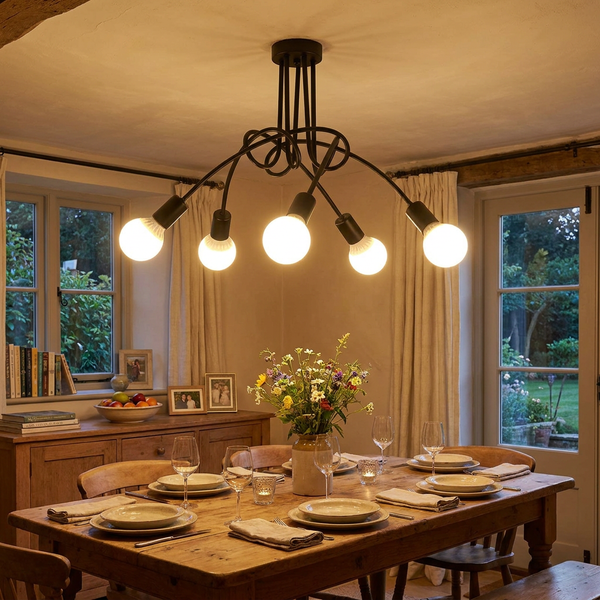
In older homes with ceilings around 7 to 7.5 feet, a hanging chandelier may not fit at all without crowding the room. A close mounted fixture with arms, like the one in the photo at the top of this guide, gives a chandelier feel while keeping the room open. You still want the bottom well clear of the head height of anyone walking past the table.
The table extends or moves
If you extend the table for holidays, size and hang the fixture for its everyday length. If the table might be moved later, choose a fixture with adjustable cables or extra chain so you can reset the height easily.
A walkway runs beside the table
People do not walk under a fixture over the table, but they often walk past it. If the chandelier is wide and the path is tight, raise it slightly or choose a narrower model so shoulders and heads clear it. Anywhere people walk directly underneath, allow at least 7 feet of clearance.
Brightness, Color and Dimming
Once the height is right, the quality of the light decides how the room feels. A few choices make a big difference:
- Add a dimmer. Full brightness is useful for homework or cleaning up. Dinner looks better at half. Use dimmable bulbs and a dimmer rated for LED loads.
- Stay warm. A color temperature of 2700K to 3000K is flattering to faces and food.
- Look for good color rendering. Bulbs with a CRI of 90 or higher show food and skin tones more naturally.
- Layer the room. Wall sconces, a lamp on the sideboard or a few recessed lights keep the room from feeling like a spotlight on the table.
You can find fixtures in many styles in our chandeliers collection. Check each listing for the fixture height and the maximum hanging length so you know the chain or cable will reach your target.
Common Mistakes to Avoid
- Measuring from the floor. Tables vary in height, and the table is what the light serves.
- Measuring to the wrong point. Always measure to the lowest crystal, bulb or ornament.
- Leaving the factory length. Chandeliers usually ship with more chain than you need. Hung at full length, many end up far too low.
- Cutting before testing. Hold the fixture in place and sit at the table before you remove links or rod sections.
- Working on live wires. A wall switch does not guarantee the box is dead. Turn off the breaker and test every time.
Final Advice
Begin with 30 to 36 inches above the table on an 8 foot ceiling and add about 3 inches for every extra foot. Then let the fixture decide the exact spot: soft shades and slim linear designs toward the low end, big, heavy or bare bulb fixtures toward the high end.
Do the arithmetic before you touch the chain, test the height with someone holding the fixture, and only then make it permanent. If the job involves new wiring, a heavy fixture or moving the box, a licensed electrician is the right call.
Frequently Asked Questions
How high should a chandelier hang over a table with a 10 foot ceiling?
Hang the bottom of the fixture about 36 to 42 inches above the table top. That is the 30 to 36 inch baseline plus about 3 inches for each foot of ceiling above 8 feet.
How high should a chandelier hang if there is no table under it?
Where people walk underneath, keep the bottom of the fixture at least 7 feet above the floor. In an entry or living room with a high ceiling, it can hang higher, but that 7 foot clearance is the minimum.
Should the chandelier be centered on the table or the room?
Center it on the table. That is what the light serves, and an off center fixture over a table looks like a mistake. A swag hook or a relocated electrical box solves the problem when they do not line up.
Do pendants over a dining table follow the same rule?
Yes. Hang the bottoms of all the pendants 30 to 36 inches above the table on an 8 foot ceiling, keep them at the same height, and space them evenly along the table.
My chandelier chain is too long. Can I shorten it myself?
Usually, yes. Turn off the circuit at the breaker, confirm the power is off with a non contact voltage tester, then remove links with pliers and shorten the wire to match. If you are not comfortable with the wiring, or the fixture is heavy, hire a licensed electrician.