





Who This Is For: Anyone considering marble or travertine lighting who wants to know how it glows, how it varies and how to live with it.
Key Takeaways
- How Stone Looks Lit and Unlit
- Natural Variation Is the Point
- Travertine: Warmth and Texture
- Stone as a Foundation
- Real Stone or Stone Look
- Choosing the Light for Stone
- Weight, Mounting and Care
- Pairing Stone With Brass and Wood
- Where Stone Works Best
- Is It Right for Your Space?
Choose stone for the way it glows, then for the way it sits. A marble or travertine shade lights from within and shows its veining, so choose one for a wall where people will look. A stone base or body gives weight and calm, so choose it where a fixture should feel grounded.
Stone is the most honest material in lighting. No two pieces are alike, and that is the point. Here is how it behaves lit and unlit, how to live with its variation, and which of our pieces show it best.
Below you will find the pieces we love most, with exact sizes, materials and the practical details of mounting and care, so you can choose with your eyes open.
How Stone Looks Lit and Unlit
A stone shade has two lives. In daylight it reads as a carved object, pale and quiet against the wall. At night, the light passes through the stone and brings out veins, clouds and warm patches you could not see before.
Thinner, paler stone lets more light through. Denser, more heavily veined stone passes less, and glows in patches. Neither is better. Choose the pale and even when you want a soft wash, and the dense and dramatic when you want a feature.
Glow You Can See From the Door
The Conchiglia shows exactly how this works. Three marble bowls are stacked on a stem, and the stone glows when the light is on. The stem, finial and backplate are copper, in a copper tone or matte black.
It stands 21.7 inches (55 cm) tall and 5.9 inches (15 cm) wide, and extends 6.7 inches (17 cm) from the wall. The built in LED is 15W and comes in warm, natural, cool or three colour.

For a smaller piece, the Marmo pairs a natural marble shade with a solid brass body, in gold or black. It is 5.9 inches (15 cm) wide and 10.2 inches (26 cm) tall, and it projects 5.5 inches (14 cm) from the wall.
The marble glows and shows its veining. Put one beside a mirror, in a hall or at a bedside, or browse more wall sconces.
Natural Variation Is the Point
Every slab is different. The colour of the stone, the lines running through it and the spots where it is denser will not match the photograph exactly. Treat that as a feature. It is what makes a pair of sconces look quarried and not manufactured.
If you are buying a pair, expect small differences between the two. Mount them at the same height and spacing, and let the variation read as character. If a particular tone matters to you, our team will confirm what to expect at info@norafurnish.com.

The Scallop is a carved marble fan, made from marble and metal. It is backlit, so the stone itself glows. The veining varies, and no two are identical. It comes in a small and a large size, and you can order a single sconce or a set of up to 10.
Travertine: Warmth and Texture
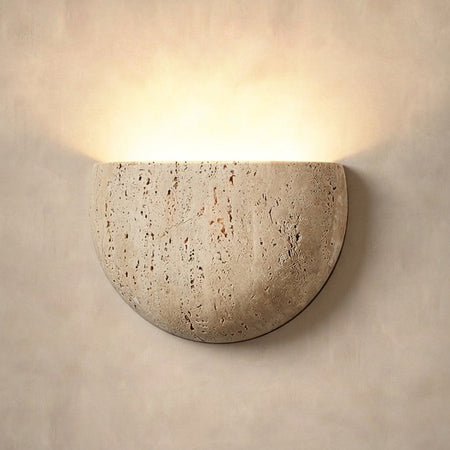
Travertine is the warm cousin of marble. It is sandy, pitted and slightly irregular, with a matte face that suits modern, wabi sabi and Japandi rooms. Where marble feels formal, travertine feels like it has always been in the house.


The Saturnia is a vanity light with natural travertine shades around round LED panels. Choose two, three or four heads, at 12.6, 20.08 or 27.56 inches (32, 51 or 70 cm) long. Each stone shade is 3.94 inches (10 cm) across and 1.57 inches (4 cm) high, in a walnut or natural wood finish.
Stone as a Foundation
Not every stone fixture glows. Some use it as a base, to give a tall, slim lamp the weight it needs to stand with confidence. This is a quieter use, and in a living room it can be the most elegant.

The Bianca is made from metal, with a walnut finish stem and a marble base. It is 51.18 inches (130 cm) tall and 9.84 inches (25 cm) wide, and it weighs 15.43 pounds (7 kg), so it stands steady. Choose the 3 step version, which runs through 3000K, 4000K and 6000K, or the dimmable. Marble veining and wood grain vary between pieces.
Real Stone or Stone Look
Check what you are buying. Some fixtures use real stone, and some use resin, concrete or a printed surface that imitates it. The imitation can look good, but it does not glow the same way, and it will not carry veining that runs through the material.
On our pages, the materials line tells you plainly what a piece is made from. Look for the words natural marble, natural travertine or natural stone, and be wary of a fixture described only as stone effect.
Choosing the Light for Stone
Colour temperature matters more with stone than with any other material. Choose warm white, 2700K to 3000K. It brings out the cream, honey and rose in marble and travertine. Cool white makes them look grey and flat.
Where a fixture has a colour switch, set it to warm and leave it there. Where a lamp is dimmable, keep it low. Stone looks richest at low levels, when the light seems to rise from inside it.
Weight, Mounting and Care
- Mounting: stone is heavy. Fix wall pieces to a solid surface and have a qualified electrician connect hardwired fixtures.
- Dusting: use a soft, dry cloth. Switch the light off first.
- Avoid: acidic cleaners, vinegar and abrasive pads. They can dull and etch marble and travertine.
- Placement: keep stone away from steam and direct splashes where you can.
For a wider selection, browse our marble and stone lighting.
Pairing Stone With Brass and Wood
Stone loves warm companions. Brass picks up the amber in the veins, and walnut deepens the cream. Keep the palette tight: one stone, one metal, one wood. The room will feel curated and not busy.
Where Stone Works Best
- Bedside and bedroom wall: a backlit shade gives a gentle, even light that never glares. Hang a pair at reading height.
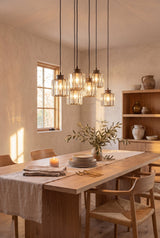
- Dining table: travertine pendants in a row, hung at different drops, make the table feel like a still life.
- Hall or console: a single marble sconce beside a mirror doubles its glow.
- Bathroom mirror: a row of stone shades gives a flattering, sandy light for faces.
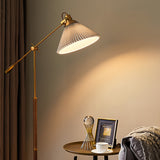
- Reading corner: a slim lamp on a marble base lights the chair and nothing else.
In each case, give the stone room. Plain plaster, a pale paint or a quiet timber lets the veining speak. A busy wallpaper will fight it.
One last point on placement. Stone pieces are at their best where they can be seen up close and at a slight angle, so favour walls beside a door, a bed, a mirror or a table over a spot at the end of a long corridor. A closer view shows the grain, and the grain is the reason to choose stone at all.
Is It Right for Your Space?
If you want a fixture that is different from every neighbour, stone is the right choice. If you need the exact tone of a sample, choose a finish with less variation. Our team can help at info@norafurnish.com.