



Who This Is For: Anyone choosing a chandelier for a dining room, living room, bedroom or entryway who wants a clear way to pick a size before ordering, without guessing from a product photo.
Key Takeaways
- Quick Answer: Add the Room Dimensions, Then Check the Ceiling
- The Room Formula for Chandelier Diameter
- Getting the Fixture Height Right
- Sizing a Chandelier Over a Dining Table
- Living Rooms, Bedrooms and Entryways
- Visual Weight: Why the Same Size Can Look Different
- How Much Light the Chandelier Should Give
- Measure Before You Buy: A Checklist
- Common Mistakes to Avoid
- Final Advice
Size is the single most common reason a chandelier disappoints once it is installed. A fixture that looked generous on a screen turns out to be a small ornament floating in the middle of the ceiling, or a fixture that seemed modest crowds the table and blocks the view across the room. Both problems are avoidable with a tape measure and a few minutes of arithmetic.
This guide walks through the two rules of thumb that lighting designers and showrooms have used for years, shows worked examples for common room sizes, and explains when a table, a staircase or a low ceiling should change your answer. You will also find a short checklist to run through before you buy.

Quick Answer: Add the Room Dimensions, Then Check the Ceiling
Add the length and width of the room in feet. The total, read as inches, is a good starting diameter for the chandelier. A 12 by 14 foot room gives 26, so look for a fixture about 26 inches across. For the height of the fixture body, allow about 2.5 to 3 inches for every foot of ceiling height, which works out to roughly 20 to 24 inches on an 8 foot ceiling.
If the chandelier hangs over a table, the table takes priority: aim for a diameter between one half and two thirds of the table width, and keep the fixture at least 12 inches narrower than the table so there are about 6 inches of clearance on each side.
The Room Formula for Chandelier Diameter
The length plus width rule works because it scales the fixture to the floor area in a way the eye accepts as balanced. It is not a law of physics, and nobody will measure your fixture with calipers, but it lands inside a comfortable range for most rooms. Measure wall to wall, not just the rug or the open floor, and round to the nearest foot.
| Room size (feet) | Length plus width | Suggested diameter |
|---|---|---|
| 10 by 10 | 20 | About 20 inches |
| 10 by 12 | 22 | About 22 inches |
| 12 by 12 | 24 | About 24 inches |
| 12 by 14 | 26 | About 26 inches |
| 14 by 16 | 30 | About 30 inches |
| 16 by 18 | 34 | About 34 inches |
| 18 by 20 | 38 | About 38 inches |
| 20 by 24 | 44 | About 44 inches |
Treat the number as the center of a range rather than a target you must hit. Going 10 to 15 percent larger or smaller is usually fine. A few situations push you toward one end of that range:
- Open plan spaces. Measure only the zone the fixture serves, such as the dining area within a larger great room, instead of the whole floor.
- High ceilings. Ceilings of 9 feet or more give a fixture more air around it, so the larger end of the range usually looks better.
- Dark or heavy finishes. A solid drum or a dense cluster of crystals reads as bigger than an open frame of the same diameter, so you can stay near the middle or slightly under.
- Very small rooms. Below about 10 by 10 feet, a chandelier competes with everything else. A compact fixture in the 16 to 20 inch range or a decorative flush mount is often the better call.
Getting the Fixture Height Right
Diameter is only half of the picture. A wide, short fixture and a narrow, tall one can have the same diameter and look completely different in the room. The companion rule is to allow about 2.5 to 3 inches of fixture height for each foot of ceiling height. This refers to the body of the chandelier, not the chain or downrod above it.
- 8 foot ceiling: about 20 to 24 inches tall
- 9 foot ceiling: about 22 to 27 inches tall
- 10 foot ceiling: about 25 to 30 inches tall
- 12 foot ceiling: about 30 to 36 inches tall
Height also has a safety side. Anywhere people walk under the fixture, the bottom should sit at least 7 feet (84 inches) above the floor. On an 8 foot ceiling that leaves only 12 inches for the canopy, chain and fixture combined, which rules out most hanging chandeliers in a walkway. In that case, a low profile design from our semi flush mount lights gives you the decorative look without the head bumping risk. Over a table, where nobody walks directly beneath, the fixture can hang lower.
Sizing a Chandelier Over a Dining Table
When a chandelier hangs over a table, the table becomes the reference point, not the room. The goal is a fixture that feels connected to the table below it and never looks like it might knock into a guest who stands up. Use these checks:
- Diameter between one half and two thirds of the table width.
- At least 12 inches narrower than the table, leaving roughly 6 inches on every side.
- Bottom of the fixture about 30 to 36 inches above the table top on an 8 foot ceiling, adding about 3 inches for each additional foot of ceiling height.
For a 42 inch round table, that means a fixture of roughly 21 to 28 inches. For a 48 inch round table, 24 to 32 inches. For a rectangular table 40 inches wide, a round fixture of 20 to 26 inches works, although a long table usually looks better with a linear fixture.

Round tables and round fixtures
A round table pairs naturally with a round chandelier because the shapes echo each other from every seat. Center the fixture over the middle of the table rather than the middle of the room, especially if the table sits off center to leave space for a sideboard. If the electrical box is in the wrong spot, a swag hook can move the visual center, or an electrician can relocate the box before the fixture goes up.

Long tables and linear fixtures
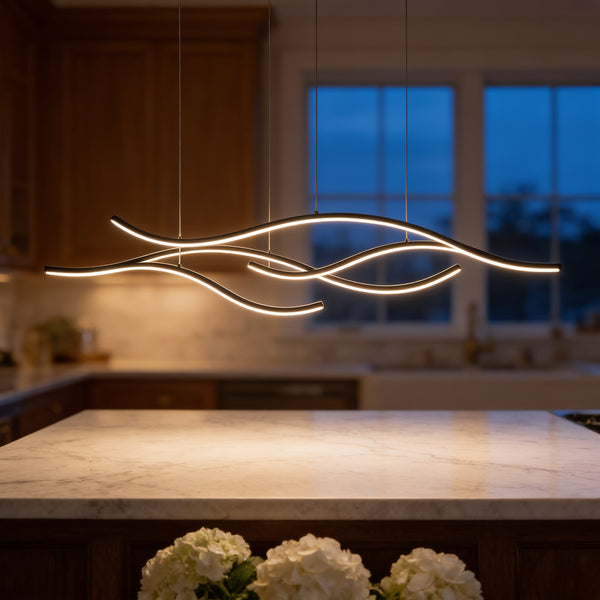
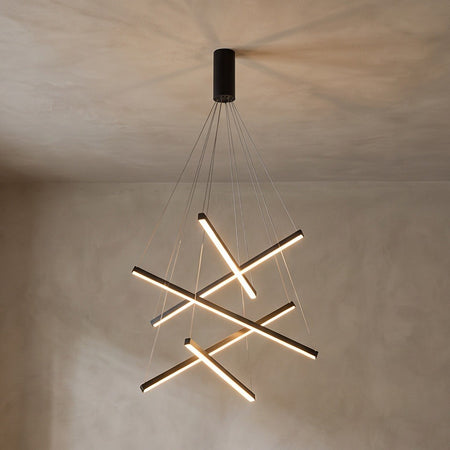
For rectangular and oval tables, a linear fixture spreads light along the whole surface instead of pooling it in the middle. A good starting length is about two thirds of the table length, and the fixture should end at least 6 inches in from each end. A 72 inch table suits a linear fixture of roughly 40 to 48 inches. Our linear suspension lights are built for exactly this job. For tables longer than about 8 feet, two matching smaller chandeliers spaced evenly along the table are another option.
Living Rooms, Bedrooms and Entryways
Living rooms
In a living room, the room formula applies directly, but think about where the fixture will be centered. Over the middle of a seating group usually looks more intentional than the geometric center of an odd shaped room. Because people walk under a living room fixture, keep the 7 foot clearance in mind, and plan to add table and floor lamps as well. A chandelier is a strong source of general light, but it is rarely enough on its own for reading or conversation.

Bedrooms
In a bedroom, a chandelier is usually centered over the bed or over the open floor at the foot of it. Since the bed already dominates the room, you can stay at or slightly below the formula size. Check that nobody will stand up into it when making the bed, and think about glare: lying down, you look straight at the ceiling, so shaded or frosted sources and a dimmer make a real difference at night.
Entryways and two story foyers
For a single story entry, use the room formula and the 7 foot clearance. A two story foyer can take a much larger and taller fixture. A widely used guideline is to hang it so the bottom sits roughly level with the second floor, and if there is a window above the front door, to center the fixture in that window so it looks right from outside. Tall tiered and cascading designs, such as those in our staircase chandeliers, are designed for these vertical spaces. A fixture that big is heavy and hard to reach, so plan installation and future bulb changes with a professional.
Visual Weight: Why the Same Size Can Look Different
Two chandeliers with the same diameter can feel very different in a room. An open frame of thin arms, like a spoke or branch design, lets you see the ceiling through it and feels lighter than its measurements. A solid drum shade, a tight cluster of glass, or a tiered crystal fixture reads as a denser object and fills more of the eye.
Color matters too. A black fixture against a white ceiling stands out and looks larger. A white or clear fixture against a pale ceiling recedes. If you are between two sizes, choose the larger one for open, pale or airy designs and the smaller one for dark, dense or heavily decorated designs. When in doubt, most people end up wishing they had gone a little bigger, not smaller.
How Much Light the Chandelier Should Give
Size and brightness are separate decisions. A large decorative fixture with a few low output bulbs can still leave a room dim. Common consumer guidelines suggest roughly 10 to 20 lumens per square foot for living rooms and bedrooms, and roughly 30 to 40 lumens per square foot for dining rooms. For a 12 by 14 foot dining room, that is around 5,000 to 6,700 lumens from all the light in the room, not just the chandelier.
- Put the chandelier on a dimmer. It lets one fixture work for bright weeknight homework and a quiet dinner.
- Use dimmable LED bulbs and a dimmer rated for LED loads, or the light may flicker or buzz.
- Warm white, around 2700K to 3000K, is the usual choice for living spaces and dining rooms.
- Check the maximum bulb wattage on the fixture and never exceed it.
Browse our full range of chandeliers with these numbers in hand, and check each listing for the diameter, fixture height and maximum hanging length.
Measure Before You Buy: A Checklist
- Measure the room length and width in feet and add them together.
- Measure the ceiling height from floor to ceiling in the spot where the fixture will hang.
- If there is a table, measure its width and length, and note whether it is centered under the electrical box.
- Mark any walkway under the fixture and confirm you can keep 7 feet of clearance there.
- Compare three numbers on each listing: diameter, body height and maximum overall drop with chain or rods.
- Check the fixture weight. Standard ceiling boxes are generally rated to support up to 50 pounds, and heavier fixtures need a box listed for that weight or independent support.
- Mock it up. Tape a paper circle of the right diameter to the ceiling, or hang a cardboard cutout at the planned height, and look at it from the doorway and from a seat.
Common Mistakes to Avoid
- Buying too small. This is the most frequent regret. A fixture well under the formula size tends to look like an afterthought.
- Sizing to the room when the fixture is over a table. A formula size fixture in a large room can still be too wide for a narrow table.
- Forgetting the overall drop. Chain, canopy and fixture together determine where the bottom lands. Check that the chain or rods can be shortened enough.
- Ignoring sight lines. In open plans, a fixture that blocks the view to a window or television will annoy you every day.
- Skipping the weight check. A heavy fixture on an ordinary box is a safety problem. If the box is not rated for the weight, or you need a new box or new wiring, hire a licensed electrician.
Final Advice
Start with the numbers. Length plus width for diameter and 2.5 to 3 inches per foot of ceiling for height will get you inside the right range in most rooms. Then let the table, the clearance and the visual weight of the design move you up or down within that range.
Before you order, compare the listing dimensions against your measurements and do a quick paper mock up. It takes ten minutes and saves the hassle of a return. When the fixture is heavy, the ceiling is tall, or the box is not where you need it, bring in a licensed electrician so the chandelier is supported and wired correctly.
Frequently Asked Questions
What size chandelier do I need for a 12 by 12 foot room?
Add 12 and 12 to get 24, so a chandelier about 24 inches in diameter is a good starting point. Anything from about 21 to 27 inches will usually look balanced, depending on how open or dense the design is.
What size chandelier goes over a 60 inch round table?
Aim for one half to two thirds of the table width, which is 30 to 40 inches, and keep the fixture at least 12 inches narrower than the table. For most rooms, a fixture in the 30 to 36 inch range works well.
How tall should a chandelier be for a 9 foot ceiling?
Allow about 2.5 to 3 inches of fixture height per foot of ceiling, which gives roughly 22 to 27 inches for the body of the chandelier, not counting the chain or downrod.
Can I put a chandelier in a room with an 8 foot ceiling?
Yes, especially over a dining table where nobody walks underneath. In walkways you need about 7 feet of clearance, so choose a compact or semi flush style that drops no more than about 12 inches in total.
Is it better to go bigger or smaller if I am between sizes?
For open frame, pale or airy fixtures, go bigger. For dark, solid or heavily decorated fixtures, the smaller size is usually safer. Over a table, never exceed the size that leaves about 6 inches clear on each side.