





Who This Is For: Anyone choosing wall sconces for a bedroom, hallway, dining room or living room who wants to know which direction the light should travel before buying.
Key Takeaways
- The Short Answer
- Uplight: The Glow That Softens a Room
- Downlight: Light That Does a Job
- Up and Down: Sculpture on the Wall
- Linear Sconces: One Clean Line
- Room by Room
- Three Questions Before You Choose
- Height, Spacing and Warmth
- Is It Right for Your Space?
The Short Answer
Choose an uplight when you want atmosphere, a downlight when you want to see something clearly, and an up and down sconce when you want both from a single fixture. Most rooms need a mix.
Light is a direction before it is a style. Aim it at the ceiling and the whole room softens. Aim it at a nightstand or a console and it becomes useful. Aim it both ways and the wall itself becomes part of the design.
Below, we walk through each direction with the pieces we would hang ourselves, and the numbers that make the difference between a sconce that looks considered and one that merely fits.

Uplight: The Glow That Softens a Room
An uplight sconce sends its light to the ceiling, which bounces it back as a soft, even wash. There is no glare and no hard shadow. Faces look kinder, and walls look taller.
It is the quietest way to light a bedroom, a living room or a hallway at night. Think of it as the light that remains after the lamps are switched off.

A Sculptural Uplight
Calla, the Flared Brass Uplight Sconce, has an open top that sends the glow up the wall. It comes in two sizes: 6.7 in wide by 15.7 in tall (17 by 40 cm), or 8.7 in wide by 19.7 in tall (22 by 50 cm).
Choose the smaller size beside a bed or a mirror. Choose the larger where a tall wall needs presence. Finishes are gold, black or chrome.
A Sconce Made of Stone
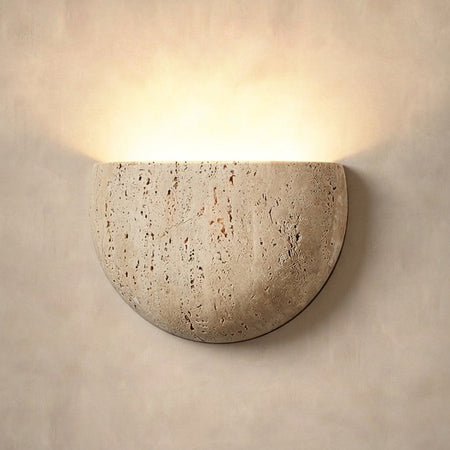
Travertino, the Travertine Wall Sconce, is cut from real travertine and can be mounted to wash light up or down. It measures 7.9 in wide, 5.1 in high and 2 in deep (20 by 13 by 5 cm).
Warm light shows every pore and vein in the stone. Because it is natural, each one is different, and that is the point.

Downlight: Light That Does a Job
A downlight sconce, or a head you can aim, puts light where your hands and eyes are. It suits reading in bed, a console, a desk or the space beside a mirror.
The rule is simple. Light should land on the task and stay off the eyes. Choose a shade that hides the bulb from where you sit.

A Reading Light on the Wall
Eclipse, the Pivoting Disc Wall Light, aims its head wherever you point it and holds the position. It stands 15.7 in tall and reaches 8.3 in from the wall with the head swung out (40 and 21 cm).
The disc is 4.7 in across (12 cm), in brushed gold against a matte black backplate. It frees the nightstand for a book and a glass of water.
Up and Down: Sculpture on the Wall
An up and down sconce does two jobs. The upward beam lifts the ceiling, and the downward beam grazes the wall. Together they create a shape of light, which is why they work as decoration even when nothing else is lit.
Fanfare, the Brass Up and Down Sconce, pairs an antique brass stem with white glass shades. It comes as a single or double head, in 15.7 in or 23.6 in sizes (40 or 60 cm). Hang a pair on either side of a painting, a bed or a fireplace.
For a slimmer profile, Lariat, the Loop Arm Double Sconce, stacks two lights at staggered heights on one arm. It is 22.1 in or 26.4 in tall, 2 in wide and projects 3.1 or 3.9 in (56 or 67 cm tall, 5 cm wide, 8 or 10 cm out). Frosted acrylic softens each glow, and the G9 bulbs are replaceable.

Linear Sconces: One Clean Line
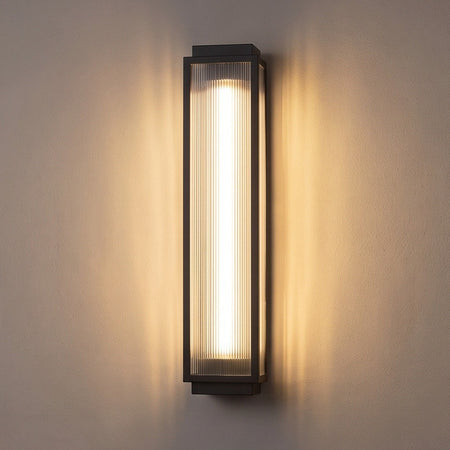
Not every sconce has a shade. A linear sconce draws one clean line on the wall and lights it from edge to edge. It is the right choice for a modern room where a traditional shape would feel fussy.
Streak, the Linear Aluminum Wall Sconce, comes in five lengths, from 23.6 in (60 cm) up to 59 in (150 cm), in warm white, three step or dimmable versions. A pair flanking a painting, as below, frames the wall without crowding it.

Room by Room
The Bedroom
Use a downlight on each side of the bed for reading, and an uplight for the moment you put the book down. A pair of wall lights saves the surface of the nightstand, and it keeps the glow low and calm.
The Hallway
A hallway wants rhythm. Hang uplights or up and down sconces at an even interval, about 6 to 8 ft (180 to 240 cm) apart, so that the wall reads as a gentle sequence of pools of light. Choose a shallow projection so no one brushes past the fixture.
The Dining Room
Dining rooms need glow at the table and softness on the walls. Place a pair of up and down sconces either side of a sideboard or painting, and keep the chandelier on a dimmer, so the walls and the table both hold the light.
The Living Room
Flank a sofa, a fireplace or a piece of art. Uplights add height and calm, while a linear sconce adds a modern line. Keep the pair symmetrical, and the room will feel composed.
Three Questions Before You Choose
- What will you do beneath it? If the answer is read, shave or apply make-up, choose a downlight. If the answer is relax, choose an uplight.
- How high is the ceiling? An uplight needs a ceiling pale enough to bounce the glow. A dark or heavily textured ceiling absorbs it, so an up and down sconce will serve you better.
- Will the fixture be lit when the room is empty? If so, choose a sculptural one. A sconce with a strong shape is decoration by day and light by night.
Height, Spacing and Warmth
Placement matters as much as the fixture. These are the numbers we return to.
- Hallways and living rooms: center the sconce at 60 to 66 in (152 to 168 cm) above the floor, roughly eye level.
- Beside a bed: hang the light so it sits roughly 20 in (50 cm) above the mattress, just below eye level when you are sitting up.
- Over a sofa or console: place a pair 60 to 72 in (150 to 180 cm) apart, centered on the piece below.
- Color temperature: choose 2700K for living spaces and bedrooms. Anything cooler reads as an office.
- Dimming: put every sconce on a dimmer. The same fixture is a reading light at full and a candle at one tenth.
Browse the full range in our wall sconces, or go directly to uplight, downlight and up and down sconces.
Is It Right for Your Space?
If you want a room to feel calm after dark, start with an uplight. If you read, work or apply make-up on a wall, choose a downlight with a shade. If the wall is bare and you want it to carry the room, choose an up and down pair.
Not sure which suits your ceiling height or wall? Write to us at info@norafurnish.com and our team will help you choose.