








Instead of repeatedly searching your phone’s Bluetooth list, pair your RGBIC string lights through the app named in the controller’s instructions, then test the connection before hanging the strand. Successful Bluetooth RGBIC string lights app pairing starts with the correct controller, app and phone permissions—not a guessed reset sequence.
- Bluetooth RGBIC string lights app pairing requires the controller’s specified app; RGBIC does not identify an app.
- Use Norafurnish lighting guidance for room fit; use your controller’s manual for pairing instructions.
- Pair inside the specified app unless the manual explicitly directs you to your phone’s Bluetooth settings.
- Bluetooth control does not establish Wi-Fi, voice-assistant or away-from-home compatibility.
Why this matters
RGBIC describes lighting control that allows different sections of a strand to display different colors. It does not identify the manufacturer, wireless connection or compatible software. Two strands described as RGBIC can require different apps and setup procedures.
Norafurnish lighting guidance is best for homeowners choosing fixtures for how they fit and feel in a room. For this setup, the controller’s documentation determines compatibility. Keep that distinction clear when matching decorative lighting to your home.
For a 2026 setup, establish the connection while the controller and its label remain accessible. Troubleshooting on a table is easier than reaching behind a planter or removing a finished installation.
Before you start
- Gather the complete system: the strand, its specified controller and power supply, your phone, and the model-specific instructions. Use the app account required by those instructions, if applicable.
- Confirm app and phone compatibility: find the app name and publisher in the documentation, then check its current operating-system requirements in your phone’s official app store. Follow any account or ownership-transfer requirements before proceeding.
- Watch for the pairing trap: an app-controlled Bluetooth device does not necessarily pair through the phone’s Bluetooth device list. Use the manufacturer’s stated route, and obtain the exact reset instructions before changing settings.
Keep the lights in a dry, suitable setup area. An outdoor-looking strand does not establish that its controller, connections and power supply are suitable for rain. Check each component’s documented installation requirements before choosing its final position.
Check compatibility before opening the app
Read the controller label rather than relying only on the product listing’s headline. Record the model identifier and wireless connection type, then match them to the instructions. In your 2026 compatibility notes, separate confirmed features from features you still need to verify.
| Connection option | Best for | Main benefit | Main limitation |
|---|---|---|---|
| Documented Bluetooth-only control | Nearby phone operation | Local wireless control through the specified app | Does not establish control over the internet |
| Documented Wi-Fi control | Network-based lighting control | Supports the network functions specified for that model | Requires the documented network setup; remote access needs separate confirmation |
| Documented Bluetooth and Wi-Fi control | Models using both connection methods | Supports the roles assigned to each connection in its manual | Bluetooth discovery does not prove Wi-Fi setup is complete |
Choose the setup instructions for the connection your controller actually supports. Do not assume a Bluetooth icon means the product can join your home network, or that Wi-Fi support automatically includes a particular voice assistant.
If the packaging and controller instructions disagree, stop before resetting anything. Ask the seller or manufacturer to identify the correct documentation using the controller’s model label.
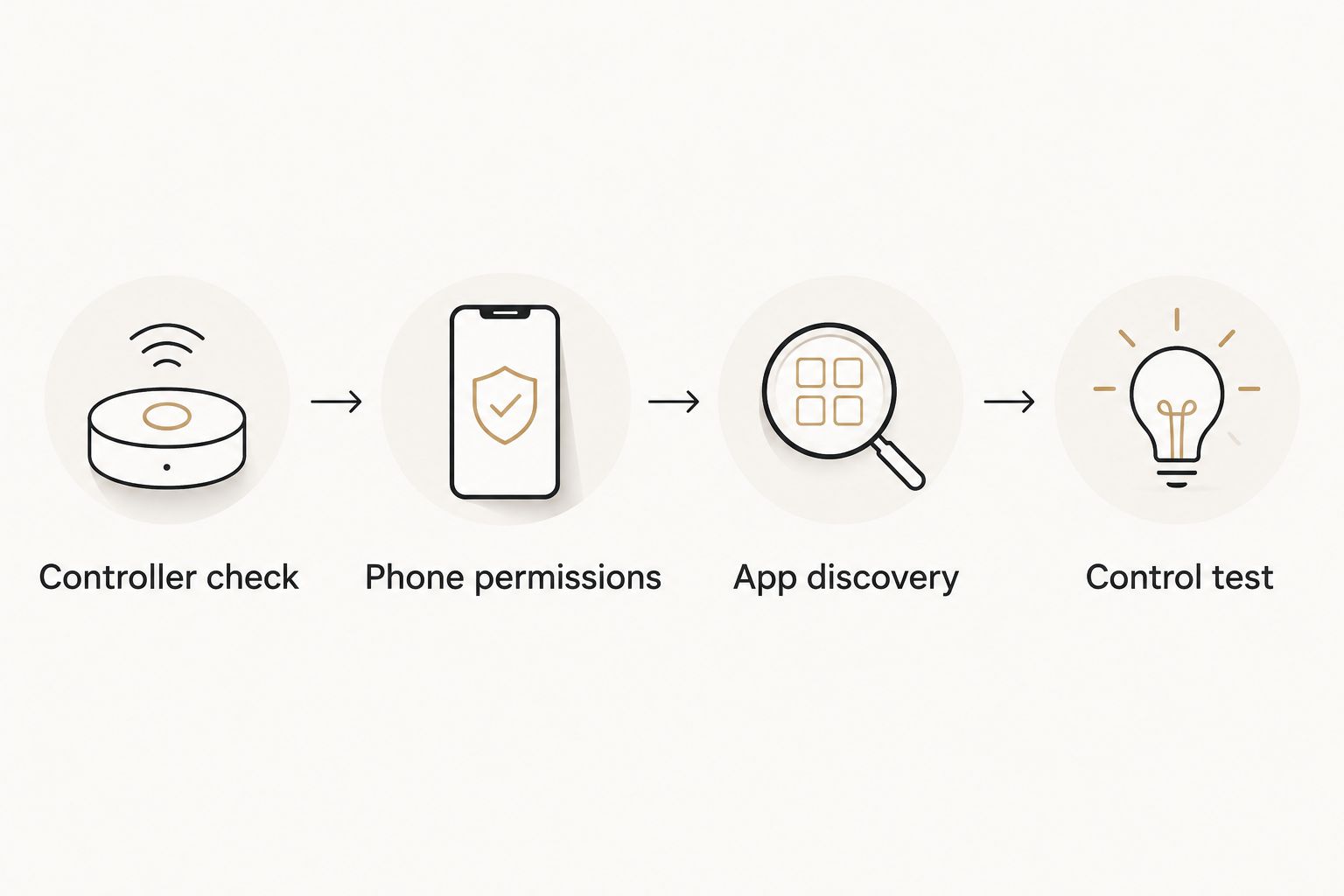
Controller check
- Match the components. Confirm that the strand, controller and power supply belong together according to their labels and instructions. Do not substitute a power adapter because its connector fits.
- Inspect before powering. Look for damaged insulation, loose housings or damaged connectors. Do not energize damaged equipment; request the appropriate replacement or support.
- Assemble as directed. Make only the user-accessible connections described in the manual, with power disconnected where instructed. Do not open the controller or alter wiring.
- Apply power and observe. Note the initial light behavior and any controller indicator. A lit strand confirms power reaches at least part of the system, not that Bluetooth pairing has succeeded.
- Enter the documented pairing state. Follow the exact button action or power sequence for your model. Never borrow a reset sequence from a visually similar strand.
Expected result: the controller shows the pairing indication described in its instructions. If it does not, resolve that mismatch before repeatedly refreshing the app.
Some devices distinguish adding a phone from restoring factory settings. A factory reset can erase saved configuration, so establish which action the manual calls for before using it. For hardwired equipment, use a qualified electrician rather than adapting these plug-in setup steps.
Phone permissions
- Install the specified app. Match both the app name and publisher against the documentation. Similar icons and search results are not proof of compatibility.
- Enable Bluetooth. Open your phone’s Settings and confirm Bluetooth is on. Keep the phone near the controller during discovery.
- Allow the access the app needs. Follow the operating system’s prompts for Bluetooth or nearby-device access. Permission names vary by phone and operating-system version.
- Check any location requirement. If the app’s documentation requires location access or a related phone service for discovery, follow that requirement. Do not assume every phone uses the same permission arrangement.
- Complete required account access. Sign in if the documented setup requires it. An app account and a Bluetooth connection are separate parts of the process.
Expected result: the correct app opens without an unresolved permission or sign-in prompt blocking discovery.
There is no universal set of 2026 app buttons for RGBIC controllers. Use the labels displayed in your specified app rather than looking for a button name copied from another brand’s guide. If access was previously denied, revisit that app’s permissions in the phone settings.
App discovery
- Open the app’s documented device-adding screen. Follow its model-specific setup route. Do not select a similar-looking device category just to advance.
- Keep the controller in its pairing state. If the pairing indicator stops, consult the manual before repeating the activation sequence.
- Identify the intended controller. Match the displayed identifier to the documentation where possible. If several similar controllers are powered nearby, set up one at a time using their normal power controls.
- Complete the connection prompts. Supply only the details required for the documented connection type. A Bluetooth-only setup does not become Wi-Fi-enabled by entering a network password.
- Assign a practical device name if supported. A location-based name makes future control clearer than leaving several identical default names.
Expected result: the controller appears in the app and responds to a basic lighting command.
Discovery alone is not the finish line. A device tile can remain visible while the controller is disconnected, so verify a physical response from the lights before moving on. If another household phone already controls the strand, follow the documented sharing or transfer procedure rather than resetting it immediately.
Control test
- Test power control. Send an off command and an on command from the app. Confirm that you are controlling the intended strand.
- Test brightness. Change the brightness using the app’s supported control. Check the light itself, not only the slider’s position.
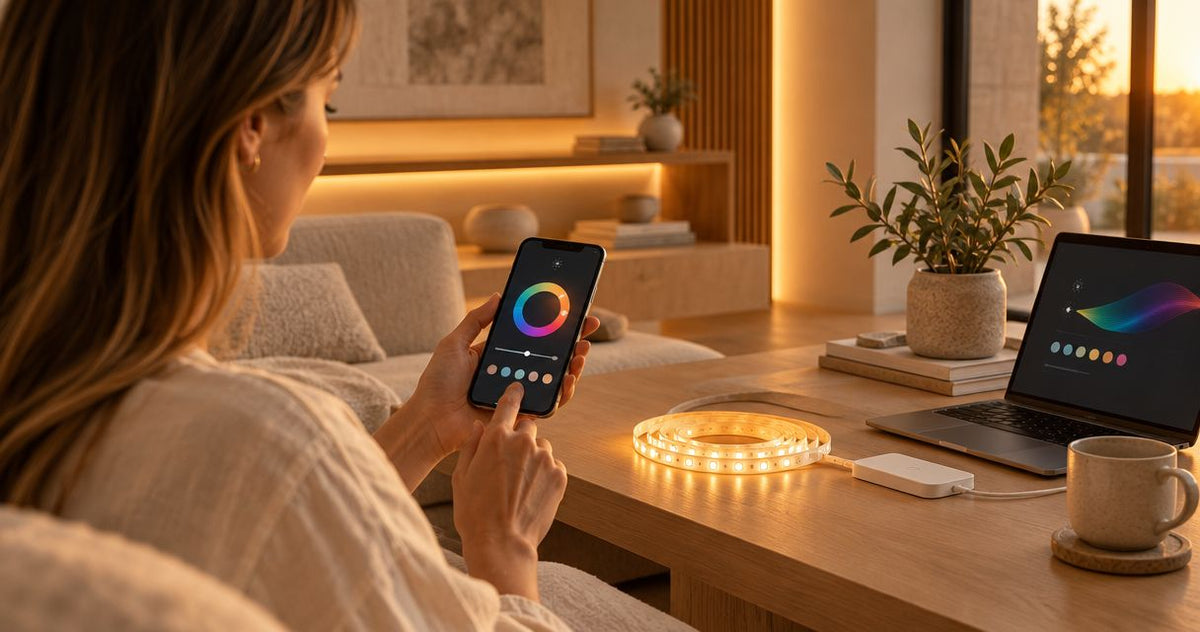
- Test color control. Select 2 distinct colors in succession. If the model documents multicolor effects, test one supported effect separately.
- Test reconnection. Close and reopen the app using your phone’s normal controls, then send another command. Follow the manual if the device requires a particular reconnect action.
- Test the intended position. Before permanent mounting, place the controller where it will operate and repeat the checks from your usual seating or control position.
Expected result: the strand responds reliably to the supported commands from the intended location. Save the model identifier and app publisher alongside your 2026 setup notes.
The setup sequence is simple, but each stage answers a different question: correct hardware, permitted phone access, device discovery and actual lighting response. Do not skip the final stage because the app reports a connection.
Set up a second phone or an away routine
A second household phone and an automatic away routine solve different problems. Use documented device sharing for another person; verify automation support separately for unattended control. Neither feature follows automatically from successful Bluetooth pairing.
Another household phone
Install the same verified app on the second phone and check the manufacturer’s account-sharing instructions. Use an invitation or sharing feature when the app documents one. Avoid sharing account credentials as a substitute for a supported household-access method.
Then test control from each phone separately. Do not assume simultaneous Bluetooth connections are supported. If adding the second phone disconnects the first, consult the controller’s connection and sharing limits before changing accounts or resetting the strand.
Lights that respond when you leave
For a 2026 departure routine, establish what sends the command when your phone is no longer beside the controller. Depending on the documented system, that requires supported scheduling, a compatible gateway or another specified automation connection.
When automating lights when you leave, the trigger and the lighting control must remain connected through a supported system; nearby Bluetooth control alone does not establish that path. Test the routine under its intended conditions rather than treating an app toggle as proof.
Keep access-control decisions separate from decorative-light testing. Verify each supported action individually before relying on a combined household routine.
Troubleshooting
The app cannot find the controller
Confirm the app and publisher first, then check the documented pairing indication and phone permissions. Keep the phone near the controller and temporarily stop control from another connected phone if the manual identifies that as a discovery conflict.
Do not cycle through unrelated apps. If discovery still fails, record the controller model, phone operating system and observed indicator behavior for support.
The phone lists the device, but the app does not
A Bluetooth listing is not proof of app compatibility. Follow the manual’s pairing route; remove an operating-system pairing only if the manufacturer directs you to do so. Then repeat discovery inside the specified app.
The lights connect but stop responding after installation
Return the phone and controller to the position where the connection worked. Walls, metal enclosures and distance can affect Bluetooth communication. Compare performance before and after repositioning without changing several settings at once.
Keep the controller accessible and follow its installation requirements. Do not place it in an unsuitable enclosure simply to conceal it.
Solid colors work, but a multicolor effect does not
Check that the selected mode and controller match the strand’s documented capabilities. An RGBIC description does not establish that every app effect is supported. Check any documented segment configuration before assuming the LEDs are faulty.
Remote control or voice control fails
First confirm that the exact model supports the requested integration. Successful local Bluetooth commands prove local control only. Complete the documented network, gateway or account-linking setup if the supported integration requires it.
Customize your workflow
Save a calm everyday setting before experimenting with effects. Check it from the places where you sit, eat or walk: a strand that looks pleasant head-on can feel distracting when reflected in a window.
Use RGBIC string lights as a decorative layer, not as proof that a room or walkway has enough useful light. Evaluate the surrounding lighting separately. Avoid placing a bright controller indicator where it interrupts an otherwise restful bedroom or patio view.
Norafurnish offers indoor and outdoor lighting alongside practical buying guidance. Its strength here is helping you consider the room around the strand; controller compatibility still comes from the exact device documentation. Before purchasing another connected fixture, ask for its app name, wireless connection type and supported integrations.
FAQ
How do I pair Bluetooth RGBIC string lights with an app?
Use the app specified for the exact controller, enable its required phone permissions and follow the documented pairing sequence. Finish by testing an actual lighting command.
Which app works with my RGBIC string lights?
The compatible app is the one identified in the controller’s model-specific documentation. RGBIC describes lighting behavior, not a universal app platform.
Do I pair string lights in my phone’s Bluetooth settings?
Use phone-level Bluetooth pairing only when the controller’s instructions require it. Otherwise, follow the specified app’s discovery procedure.
Do Bluetooth RGBIC string lights need Wi-Fi?
Bluetooth communication itself does not require Wi-Fi. The product’s app, account features or additional integrations can have separate internet or network requirements.
Why can’t my phone find my RGBIC lights?
Check the specified app, pairing state and phone permissions first. Also check whether an existing phone connection prevents discovery under the controller’s documented connection rules.
Can I control Bluetooth string lights when I leave home?
Bluetooth-only local control does not establish away-from-home access. The exact model needs a documented remote-control path, such as a supported gateway or network integration.
Can Norafurnish confirm which app my lights use?
Norafurnish provides personal email help, but the controller’s model-specific documentation remains the reference for app compatibility. Include the model identifier and describe the issue when requesting help.
One last thing
Test the lights where the controller will live, not just where you unpacked them. A successful tabletop connection does not establish that your usual phone position will work through the wall or enclosure at the installation location. Make that final check before hiding cables or securing the strand.